About 23 minutes
Christmas Roses — Reading Notes
Fantasy Juvenile Worlds
5,242 recorded words. 2 minutes difference from this book's estimate.
View Gutenberg source #25634
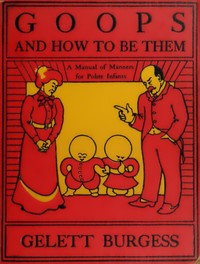
The catalog record for Goops and How to Be Them — A Closer Reading provides practical reading context through 5,573 words, 25 min estimated reading time, and 2 detected text sections.
The text analysis averages about 21.9 words per sentence, while the detected sections provide another way to judge how the source is divided.
Project Gutenberg metadata also associates the work with “Etiquette,” connecting these edition facts with the source record’s subject description.
Explore this collection
These alternatives are selected using recorded categories and estimated reading time.
About 23 minutes
Fantasy Juvenile Worlds
5,242 recorded words. 2 minutes difference from this book's estimate.
View Gutenberg source #25634About 23 minutes
Fantasy Juvenile Worlds
5,200 recorded words. 2 minutes difference from this book's estimate.
View Gutenberg source #26431About 27 minutes
Fantasy Juvenile Worlds
6,026 recorded words. 2 minutes difference from this book's estimate.
View Gutenberg source #47293Search stored excerpts and compare books → Choose by your preferences →
Choices use stored catalog measurements. Estimates vary with reading speed. A shared category is a catalog label, not a claim that two books have the same argument or literary quality.
Search reads excerpt text stored with this catalog and links to its associated Gutenberg record. The connection is stored in the site database; this tool does not recheck that every excerpt is word-for-word identical to that external record. Excerpt search does not cover every chapter and does not verify historical publication dates.
Catalog snapshot checked: 2026-09-26. Coverage: 95 public books, 95 available source excerpts.
Calculated from edition completeness, EPUB availability, text structure and catalogue metadata. Not a user rating.
Total of 100 points, scaled to a 2.5-5.0 range. Editions with an empty description or a missing EPUB file are not scored.
Public-domain source text
The source text is kept in the dedicated reader, separate from this catalogue record and its commentary.
Gelett Burgess's Goops and How to Be Them (1900) presents etiquette instruction through a cast of grotesque, nearly featureless creatures whose every action violates decorum. The book's central conceit—that children learn politeness by observing the impolite—is established in the opening poem: “Politeness from the Impolite.” The Goops are defined by their lack: “Void of Beauty and of Grace,” they have “a Paucity of Features.” Their misdeeds are cataloged in short, rhymed verses covering table manners, cleanliness, courtesy, and dozens of other domestic virtues. Each poem pairs a description of Goopish transgression with a direct or implied model of correct behavior, often addressing the child reader in second person. The verses rely on exaggerated physical details—licking fingers, spilling broth, leaving “gum stuck underneath the chair”—to make the lessons memorable through absurdity.
The Goops never reform; they remain perpetually rude. Burgess uses them as static foils, not characters who learn. In “Table Manners—I,” the Goops “lick their fingers” and “spill their broth on the tablecloth,” while the speaker declares relief at not being a Goop. The poem ends with a direct question: “are you?” This pattern recurs throughout: the Goops embody a fault, the speaker models the opposite, and the child is invited to self-assess. The method relies on contrast rather than precept. In “Cleanliness,” the Goops are “spotted on chin and on cheek” to a degree that “you could dig the dirt off with a trowel,” while the reader is reminded that washing occurs “twenty times every week.” The exaggeration makes the negative example vivid and comic, while the positive behavior is stated plainly. Burgess never explains why manners matter; he assumes the child will prefer not to be a Goop.
The poems are built on simple, repetitive meters—mostly anapestic or iambic tetrameter—and frequent refrains. “The Goops they…” opens several verses, creating a chant-like quality. In “Table Manners—I,” the first two lines begin identically: “The Goops they lick their fingers, / And the Goops they lick their knives.” This parallelism makes the behavior easy to remember and recite. Many poems list multiple offenses in quick succession: “They throw their crumbs upon the floor, / And at dessert they tease for more” (“Table Manners—II”). The catalog form allows Burgess to cover many rules in a small space. The book’s table of contents lists 44 topics, from “Table Manners” to “Cheerfulness,” each treated in a single page or less. This structure suits the intended young audience, presenting discrete lessons that can be read aloud one at a time.
Burgess dwells on bodily functions and mess. The Goops are “gluttonous and rude,” they “gug and gumble with their food,” and they are dirty enough to require a trowel. In “Neatness,” they leave “gum stuck underneath the chair” and “muddy footprints in the hall.” The poems emphasize tangible, sensory consequences of bad manners: crumbs, dirt, noise. This focus on the physical makes abstract concepts like courtesy concrete. The Goops themselves are described as “Extraordinary Creatures / With a Paucity of Features”—their lack of detail makes them universal stand-ins for any child’s misbehavior. The illustrations (not reproduced here) presumably reinforce this grotesque simplicity. The humor arises from the gap between the exaggerated Goopish behavior and the mild, reasonable alternative. Burgess never moralizes; he simply presents the Goops as disgusting and lets the reader draw the conclusion.
Goops and How to Be Them rewards reading aloud, with its strong rhythms and comic exaggerations. The verses are short enough to hold a child’s attention, and the repeated question “Are you a Goop?” invites participation. Because the book presents each rule in isolation, it can be used as a reference for specific situations. Readers may notice that the Goops never appear in the positive examples—they exist only as warnings. This consistent framing makes the book a distinctive artifact of turn-of-the-century didactic children’s literature, where humor served as the vehicle for moral instruction.
I’ve often thought the Goops—those blank, blundering figures—carry the same weight as the grave verses in An Essay on War, in Blank Verse; Honington Green, a Ballad; the Culprit, an Elegy; and Other Poems, on Various Subjects — Text and Context. Both teach through absence: the Goops show us what manners are not, and war's blankness shows peace. I’ve shelved them side by side for years, and they seem to nod, quietly, to each other.
Save your reaction, strongest insight, and memorable passage.