About 68 minutes
The Wild Knight and Other Poems — Context and Discussion
Fantasy Juvenile Worlds
15,480 recorded words. 1 minutes difference from this book's estimate.
View Gutenberg source #12037
The source record for The Englishman and Other Poems — Edition Insights measures this digital text at 15,232 words, 1 hr 7 min estimated reading time, and 2 detected text sections.
The text analysis averages about 23.3 words per sentence, while the detected sections provide another way to judge how the source is divided.
Project Gutenberg metadata also associates the work with “Poetry,” connecting these edition facts with the source record’s subject description.
Explore this collection
These alternatives are selected using recorded categories and estimated reading time.
About 68 minutes
Fantasy Juvenile Worlds
15,480 recorded words. 1 minutes difference from this book's estimate.
View Gutenberg source #12037About 73 minutes
Fantasy Juvenile Worlds
16,679 recorded words. 6 minutes difference from this book's estimate.
View Gutenberg source #11564About 59 minutes
Fantasy Juvenile Worlds
13,425 recorded words. 8 minutes difference from this book's estimate.
View Gutenberg source #3525Search stored excerpts and compare books → Choose by your preferences →
Choices use stored catalog measurements. Estimates vary with reading speed. A shared category is a catalog label, not a claim that two books have the same argument or literary quality.
Search reads excerpt text stored with this catalog and links to its associated Gutenberg record. The connection is stored in the site database; this tool does not recheck that every excerpt is word-for-word identical to that external record. Excerpt search does not cover every chapter and does not verify historical publication dates.
Catalog snapshot checked: 2026-09-26. Coverage: 95 public books, 95 available source excerpts.
Calculated from edition completeness, EPUB availability, text structure and catalogue metadata. Not a user rating.
Total of 100 points, scaled to a 2.5-5.0 range. Editions with an empty description or a missing EPUB file are not scored.
Public-domain source text
The source text is kept in the dedicated reader, separate from this catalogue record and its commentary.
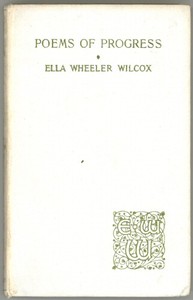
Ella Wheeler Wilcox's 1912 collection The Englishman and Other Poems opens with a title poem that immediately establishes a central tension: the speaker's New World pride yields to an acknowledgment of kinship with the Englishman, whose 'big, broad mind' and 'heart that is soft and warm' lie beneath a cold exterior. This pattern of contrasting surfaces and depths recurs throughout the volume, from the public spectacle of 'The Queen's Last Ride' to the intimate anguish of 'The Spinster.'
Wilcox employs a range of poetic forms—ballades, sonnets, dramatic monologues—to examine how individuals navigate conflicting loyalties: to nation, to nature, to self. The excerpts reveal a poet attentive to the gap between social roles and inner truths, often using natural imagery (trees, bees, roses) to frame human desires that go unanswered.
The volume's first poem, 'The Queen's Last Ride,' written on the day of Queen Victoria's funeral, treats a state occasion with intimate detail: the Queen 'wears no crown' yet is 'crowned with the love that has gone before.' Wilcox contrasts the public spectacle—purple-draped streets, flags at half-mast—with the silent, solitary journey of the 'silent lady.' This interplay between collective ritual and personal loss reappears in 'The Englishman,' where national pride gives way to a shared humanity.
In 'Coronation Poem and Prayer,' the speaker addresses a monarch with both reverence and a plea for humility: 'Let not the crown weigh heavy on thy brow.' The poems consistently question whether public roles can contain private feeling. 'The Tavern of Last Times' offers a quieter example: a Surrey inn where Nelson and Keats once lingered becomes a site where historical memory and present-day idleness meet, the lark's song indifferent to the 'idle passing throngs.'
Several poems give voice to figures whose longings are thwarted by circumstance or duty. 'The Spinster' is the most explicit: the speaker addresses God directly, asking why her 'woman's breast' and 'mother cry' go unfulfilled. She contrasts her own barrenness with the natural world—the bee 'carrying on love's laws 'twixt flower and flower'—and struggles to reconcile her 'primal woman' hunger with a 'better self' that demands a spiritual mate. The poem's three-part structure moves from complaint to understanding, yet the resolution remains tentative: 'if, in barren chastity, I must / Know but in dreams that perfect choice of me, / Still will the voice of me / Proclaim God just.'
This tension between natural instinct and spiritual aspiration appears also in 'The Squanderer' and 'Compensations,' where loss is reframed as gain. Wilcox does not offer easy consolation; instead, she dramatizes the effort to find meaning in denial. The recurring image of the tree—budding, blooming, fruiting—serves as a counterpoint to human sterility, underscoring the speaker's sense of exclusion from nature's cycles.
Wilcox varies her poetic strategies across the collection, moving from the stately quatrains of 'The Queen's Last Ride' to the sonnet form of 'The Tavern of Last Times' and the dramatic monologue of 'The Spinster.' This formal range mirrors the shifting perspectives she adopts: the patriotic speaker of the title poem, the devout petitioner of 'Coronation Poem and Prayer,' the skeptical questioner of 'The Spinster.'
In 'Brotherhood,' she uses a simple ballad stanza to argue that only 'some crucial hour of pain' can awaken 'consciousness of brotherhood.' The poem's directness contrasts with the more ornate language of 'The Two Ages,' where a cathedral window's beauty is undercut by 'the taste of blood that stained that age of art.' Wilcox is not afraid to juxtapose the lofty and the blunt, the personal and the political. Even within a single poem, as in 'The Englishman,' she moves from flaunting 'New World pride' to claiming kinship with the very figure she initially resists. These formal and tonal shifts keep the reader alert to the poems' central concern: the difficulty of holding conflicting truths together.
Readers approaching The Englishman and Other Poems will find a poet who uses conventional forms to unsettle conventional pieties. Wilcox's speakers are often caught between what they feel and what they are expected to say, and the poems reward attention to their moments of hesitation and reversal. The collection does not resolve its tensions; instead, it presents them as the very substance of human experience. Let the poems speak in their own voices, and note how often they return to the image of a journey—royal, solitary, or shared—that never quite reaches its destination.
I sometimes think of Wilcox’s 1912 volume, with its brave public postures masking private ache, and then recall how Mountain Idylls hushes that same conflict into quiet granite-shadowed verse. Both books knew the weight of solitary thought. One shouts it at the sea; the other whispers it to pines. Mountain Idylls, and Other Poems — Reading Notes feels like the answering sigh.
Save your reaction, strongest insight, and memorable passage.