About 122 minutes
Lilliput Lyrics — Themes and Context
Fantasy Juvenile Worlds
27,929 recorded words. 2 minutes difference from this book's estimate.
View Gutenberg source #53030
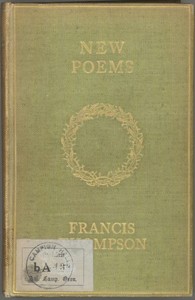
For New Poems — Text and Context, the stored edition analysis reports 28,378 words, 2 hr 4 min estimated reading time, and 4 detected text sections.
The text analysis averages about 25.2 words per sentence, while the detected sections provide another way to judge how the source is divided.
Project Gutenberg metadata also associates the work with “English poetry,” connecting these edition facts with the source record’s subject description.
Explore this collection
These alternatives are selected using recorded categories and estimated reading time.
About 122 minutes
Fantasy Juvenile Worlds
27,929 recorded words. 2 minutes difference from this book's estimate.
View Gutenberg source #53030About 106 minutes
Fantasy Juvenile Worlds
24,379 recorded words. 18 minutes difference from this book's estimate.
View Gutenberg source #6957About 106 minutes
Fantasy Juvenile Worlds
24,270 recorded words. 18 minutes difference from this book's estimate.
View Gutenberg source #9652Search stored excerpts and compare books → Choose by your preferences →
Choices use stored catalog measurements. Estimates vary with reading speed. A shared category is a catalog label, not a claim that two books have the same argument or literary quality.
Search reads excerpt text stored with this catalog and links to its associated Gutenberg record. The connection is stored in the site database; this tool does not recheck that every excerpt is word-for-word identical to that external record. Excerpt search does not cover every chapter and does not verify historical publication dates.
Catalog snapshot checked: 2026-09-26. Coverage: 95 public books, 95 available source excerpts.
Calculated from edition completeness, EPUB availability, text structure and catalogue metadata. Not a user rating.
Total of 100 points, scaled to a 2.5-5.0 range. Editions with an empty description or a missing EPUB file are not scored.
Public-domain source text
The source text is kept in the dedicated reader, separate from this catalogue record and its commentary.
Francis Thompson's New Poems (1907) opens with a dedication to Coventry Patmore, whose 'crested and prevailing Name' Thompson invokes as a shield against oblivion. The collection immediately establishes a voice that is both reverent and audacious, blending archaic diction with startling sensory images. In 'The Mistress of Vision,' the garden is 'Set i' the pathless awe / Where no star its breath can draw,' a line that typifies Thompson's tendency to yoke the abstract with the physical. His syntax often twists into inversions ('Mine eyes saw not, and I saw'), creating a rhythm that feels both liturgical and urgent. The poems are organized into thematic sections—'Sight and Insight,' 'A Narrow Vessel,' 'Miscellaneous Odes'—suggesting a deliberate architecture of spiritual and emotional exploration.
Thompson's vocabulary draws heavily on Latinate and theological terms ('inimitable,' 'immitigable,' 'inaureole'), yet he grounds them in concrete, often bodily imagery. In 'The Mistress of Vision,' the Lady's tears are 'divine conservers' that wash the lily, and her blood flows through the flowers' 'nervures.' This fusion of the sacred and the organic recurs throughout: the moon is a 'white sufficing woman,' and light is 'heavenly-human.' The poet does not shy from paradox—'sweet-panged singing' and 'fair weeping'—to express experiences that transcend simple emotion. Such word choices create a texture that is both ornate and visceral, inviting the reader to linger on each phrase.
Several poems adopt a first-person voice that is at once confessional and defiant. In 'Against Urania,' the speaker laments that Song, a goddess, has deceived him: 'worse than other women she can deceive.' He describes casting 'Life, love, and health, / Content, and wealth' before her, only to be left 'to implore / Remembered boon in bitterness of blood.' This persona—the poet as a devoted but betrayed lover of his art—is further developed in 'A Captain of Song,' where Coventry Patmore is portrayed as one who has 'trod the ways afar, / The fatal ways of parting and farewell.' The speaker warns that only those who have 'trod the self-same way' can truly approach such a soul. Thompson's voice here is intimate yet oracular, blending personal anguish with a broader meditation on poetic vocation.
Thompson employs structural devices that echo liturgical and incantatory traditions. In 'The Mistress of Vision,' the refrain 'Mine eyes saw not, and I saw' recurs, emphasizing the paradox of visionary experience. The poem 'Any Saint' uses a repeated line 'What word hadst thou for me?' to frame its inquiry. In 'A Captain of Song,' the phrase 'the words abhorred of comfortable men' is repeated with slight variation, hammering home the isolation of the poet. These repetitions are not mere ornament; they create a rhythmic insistence that mirrors the speaker's obsessive themes. The section 'A Narrow Vessel' presents a sequence of love poems with titles like 'A Girl's Sin—in her Eyes' and 'The End of it,' suggesting a narrative arc told through contrasting perspectives—a structural choice that adds dramatic tension.
Thompson's imagery frequently draws on celestial and elemental forces. In 'The Mistress of Vision,' the Lady's body is 'with that light was interstr[...]' (the excerpt cuts off), and the moon is a 'white sufficing woman.' The 'Anthem of Earth' addresses 'Immeasurable Earth' moving through 'the loud vast and populacy of Heaven, / Tempested with gold schools of ponderous orbs.' Light is often described as a garment or a substance: 'a sun-derivèd stole' and 'light most heavenly-human.' Conversely, darkness and hell are rendered with physical intensity: 'the travel-heats of hell' and 'the moonless mere of sighs.' This cosmic scale does not diminish the personal; rather, it amplifies the speaker's inner drama, making his spiritual struggles feel as vast as the universe itself.
Readers approaching New Poems should attend to Thompson's idiosyncratic punctuation and lineation, which often disrupt conventional syntax to mimic the hesitations and rushes of thought. The poems reward slow reading; many are built around a central paradox or image that unfolds gradually. The collection's arrangement—from visionary odes to intimate lyrics—invites comparison across sections, revealing a poet who consistently tests the boundaries between the earthly and the divine. Let the language itself guide your interpretation: Thompson's words are not merely vehicles for meaning but objects of contemplation in their own right.
Reading Thompson's New Poems — Text and Context, I kept returning to those muddy paradoxes—light tangled in dirt, grace with a limp. It reminded me of a quieter afternoon spent with The Ducks and Frogs, a Tale of the Bogs. — A Closer Reading, where the same odd tenderness lives in wet, common places. Something about finding the holy crouched low.
A brief reflection can help important ideas stay with you longer.