About 28 minutes
The Cowslip; Or, More Cautionary Stories, in Verse — Inside the Classic
Fantasy Juvenile Worlds
6,429 recorded words. 1 minutes difference from this book's estimate.
View Gutenberg source #45275
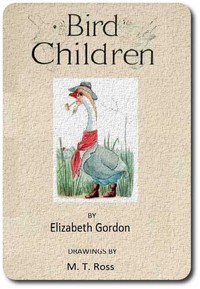
Bird Children: The Little Playmates of the Flower Children — Inside the Classic can be approached with a clearer sense of reading commitment from its source measurements: 6,026 words, 27 min estimated reading time, and 3 detected text sections.
The text analysis averages about 24.6 words per sentence, while the detected sections provide another way to judge how the source is divided.
Project Gutenberg metadata also associates the work with “Children's poetry, American,” connecting these edition facts with the source record’s subject description.
Explore this collection
These alternatives are selected using recorded categories and estimated reading time.
About 28 minutes
Fantasy Juvenile Worlds
6,429 recorded words. 1 minutes difference from this book's estimate.
View Gutenberg source #45275About 25 minutes
Fantasy Juvenile Worlds
5,573 recorded words. 2 minutes difference from this book's estimate.
View Gutenberg source #36664About 30 minutes
Fantasy Juvenile Worlds
6,760 recorded words. 3 minutes difference from this book's estimate.
View Gutenberg source #41945Search stored excerpts and compare books → Choose by your preferences →
Choices use stored catalog measurements. Estimates vary with reading speed. A shared category is a catalog label, not a claim that two books have the same argument or literary quality.
Search reads excerpt text stored with this catalog and links to its associated Gutenberg record. The connection is stored in the site database; this tool does not recheck that every excerpt is word-for-word identical to that external record. Excerpt search does not cover every chapter and does not verify historical publication dates.
Catalog snapshot checked: 2026-09-26. Coverage: 95 public books, 95 available source excerpts.
Calculated from edition completeness, EPUB availability, text structure and catalogue metadata. Not a user rating.
Total of 100 points, scaled to a 2.5-5.0 range. Editions with an empty description or a missing EPUB file are not scored.
Public-domain source text
The source text is kept in the dedicated reader, separate from this catalogue record and its commentary.
Elizabeth Gordon's Bird Children (1912) presents a series of short, rhymed poems that personify birds as playful, distinct individuals. Each poem is a compact character sketch, using simple meter and direct address to give each bird a recognizable voice. The collection is structured as a companion to Gordon's earlier Flower Children, and the poems are designed to be both instructive and entertaining, introducing young readers to a variety of bird species through memorable, anthropomorphic traits.
Gordon's poems consistently employ a four-line, AABB rhyme scheme, creating a predictable, song-like rhythm that suits the subject matter. The opening lines often establish a bird's defining characteristic: Sir Rooster is a "noisy chap" who "wakes you from your morning nap," while Mrs. Hen "always dresses just the same" and "talks all day about her joys." These details are not merely descriptive; they function as mnemonic devices, linking each bird's behavior to a concise, repeatable phrase. The meter is predominantly iambic tetrameter, lending a bouncy, oral quality that invites reading aloud. Gordon's word choices are deliberately simple—"nice buckwheat," "good, simple food"—reflecting an audience of young children. Yet within this simplicity, she varies the tone: the Gosling's self-deprecating humor ("I can't get learning through my head") contrasts with the Guinea Hen's fussy maternal concern. Each poem thus becomes a miniature performance, with the bird's personality emerging through the rhythm and diction.
The poems consistently translate bird behaviors into human social situations. The Yellow Duckling's desire to hide from his mother, the Gosling's worry about becoming a goose, and the Guinea Hen's preference for "three-cornered grains" all map avian instincts onto recognizable childhood experiences. This technique makes the natural world accessible without sacrificing accuracy: the Duckling's hiding impulse mirrors real duckling behavior, but it is framed as a mischievous game. Gordon also embeds factual details within the anthropomorphic frame. The Rooster's crowing at "eleven, one and two" reflects actual rooster behavior, while the Hen's egg-laying is presented as a proud achievement. The poems thus serve a dual purpose: they entertain with personified characters while subtly conveying biological facts. The foreword explicitly states the book's "instructive features," and the poems deliver on this promise by making each bird's habits the core of its poetic identity.
M. T. Ross's illustrations are integral to the book's effect, as indicated by the title page crediting "Drawings by M.T.Ross." The poems are short enough to pair with a single image per bird, and the visual component likely reinforced the characterizations. For instance, the Rooster's "noisy chap" description would be complemented by an image of a crowing rooster, while the Hen's "kind old dame" portrayal would be matched by a maternal pose. The text itself contains visual cues: the Gosling's "downy" appearance, the Guinea Hen's "Huffy little brood." These adjectives invite the illustrator to emphasize texture and expression. The collaboration between Gordon and Ross is typical of early 20th-century children's books, where text and image work in tandem to create a unified, memorable character. The book's sixth edition suggests its popularity, and the consistent pairing of poem and picture likely contributed to its appeal as a learning tool.
The poem sequence in Bird Children follows a deliberate progression from familiar domestic birds to more exotic species. The opening poems feature the Rooster, Hen, Guinea Hen, Gosling, Goose, and Duckling—birds a child might encounter on a farm. This grounding in the familiar builds confidence before introducing more unusual birds like the Peacock, Ostrich, and Lyre Bird later in the collection. The index lists 95 entries, covering a wide range of species from the common Sparrow to the rare Roseate Spoonbill. This structure mirrors the educational goal: start with what children know, then expand their horizons. The poems themselves do not vary in form or complexity, maintaining a consistent reading level throughout. This uniformity ensures that the focus remains on the bird's character rather than on decoding the verse. The sequence thus functions as a gentle introduction to ornithological diversity, using the familiar rhythm of the poems as a scaffold for new information.
Readers approaching Bird Children will find a consistent, rhythmic structure that rewards reading aloud. The poems are best appreciated as individual vignettes, each offering a quick, vivid impression of a bird's personality. The book's value lies in its ability to make natural history feel like a cast of characters, inviting children to observe real birds with the same playful curiosity that Gordon brings to her verses.
There’s something tender in how Elizabeth Gordon gives each bird its own little voice, as if childhood itself were perched on a branch. I found myself thinking of that quietness again while leafing through Canada and Other Poems — Inside the Classic; different landscape, same hush of noticing. Some books just hum along beside you, like old friends remembered mid-spring.
Your answers remain private and are stored only in this browser.