About 192 minutes
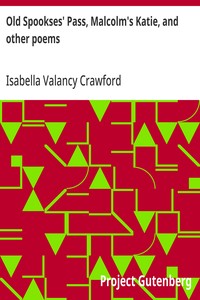
Old Spookses' Pass, Malcolm's Katie, and other poems — Key Ideas to Explore
Fantasy Juvenile Worlds
44,035 recorded words. 0 minutes difference from this book's estimate.
View Gutenberg source #6815
This digital edition of The Death of Saul and other Eisteddfod Prize Poems and Miscellaneous Verses — Themes and Context is described by source-level measurements including 43,998 words, 3 hr 12 min estimated reading time, and 6 detected text sections.
The text analysis averages about 23.8 words per sentence, while the detected sections provide another way to judge how the source is divided.
Project Gutenberg metadata also associates the work with “Poetry,” connecting these edition facts with the source record’s subject description.
Explore this collection
These alternatives are selected using recorded categories and estimated reading time.
About 192 minutes
Fantasy Juvenile Worlds
44,035 recorded words. 0 minutes difference from this book's estimate.
View Gutenberg source #6815About 204 minutes
Fantasy Juvenile Worlds
46,738 recorded words. 12 minutes difference from this book's estimate.
View Gutenberg source #10945About 124 minutes
Fantasy Juvenile Worlds
28,378 recorded words. 68 minutes difference from this book's estimate.
View Gutenberg source #1471Search stored excerpts and compare books → Choose by your preferences →
Choices use stored catalog measurements. Estimates vary with reading speed. A shared category is a catalog label, not a claim that two books have the same argument or literary quality.
Search reads excerpt text stored with this catalog and links to its associated Gutenberg record. The connection is stored in the site database; this tool does not recheck that every excerpt is word-for-word identical to that external record. Excerpt search does not cover every chapter and does not verify historical publication dates.
Catalog snapshot checked: 2026-09-26. Coverage: 95 public books, 95 available source excerpts.
Calculated from edition completeness, EPUB availability, text structure and catalogue metadata. Not a user rating.
Total of 100 points, scaled to a 2.5-5.0 range. Editions with an empty description or a missing EPUB file are not scored.
Public-domain source text
The source text is kept in the dedicated reader, separate from this catalogue record and its commentary.
J. C. Manning's preface to this 1877 collection acknowledges that the poems, written over twenty-five years, bear 'variety of sentiment and incongruity of feeling.' The volume opens with the title poem, 'The Death of Saul,' which Manning submitted to the Wrexham National Eisteddfod in a compressed 200-line version that won first prize. Here he restores it to nearly 400 lines, remarking wryly that squeezing a poem into half its length 'is an achievement worthy of a prize in itself.' This editorial note focuses on the collection's structural variety, recurring images, and movement between scenes.
Manning's prefatory remarks about 'The Death of Saul' offer a rare glimpse into the constraints of competitive verse. He describes having to 'lop away' from the original to meet the committee's limit, and compares the process to encasing his muse in 'a straight waistcoat' or 'temporary stays.' The restored poem, he implies, is more 'comprehensive' than the prizewinning excerpt. Readers can compare the two versions in spirit: the full text includes battle imagery such as 'the red blood streams, and the fire-flash gleams' and 'the hoarse-throated cannon belch fiery breath,' which may have been trimmed for the competition. The episode illustrates how institutional demands shaped Victorian poetic production.
Across the collection, natural imagery recurs as a vehicle for emotional states. In 'Unrequited,' a 'beautiful Streamlet' dances along 'with its bright brow fretted with flow'rs,' while a willow tree yearns for its affection. The streamlet 'laughed at the willow's heart-strife' and continues 'laughing away,' indifferent to the willow's death. The same pattern appears in 'The Household Spirit,' where a spirit moves 'noiseless as thistle-down upon the wind' and its cheeks are 'like languid lilies flusht with rosy wine.' These images link human feeling to natural cycles, though the tone shifts from the willow's tragic unrequited love to the spirit's comforting presence.
The collection juxtaposes public, martial scenes with intimate domestic ones. The battle passage in 'The Death of Saul' shifts rapidly from cannon fire to hand-to-hand combat: 'Crash! Crash! Then a leap and a dash! / Hand to hand—face to face, goes the fight.' In contrast, 'The Household Spirit' describes a spirit that 'stealeth up and down the stairs' and 'doth angelize each angry thought.' The poem 'To Lord Derby' addresses a political figure, praising him as 'the Voice of the Land,' while 'Had I a Heart' returns to personal loss, recalling 'days that now are o'er' by the 'sounding shore.' This alternation between grand and intimate registers gives the volume its varied texture.
Manning frames his work with a defensive yet hopeful address 'To the Public,' where he asks for 'the bright sun of Approbation' and compares himself to a lark that 'spreads his pinions for a loftier flight.' He anticipates 'chilling frowns of critics' but insists they 'cannot kill the ardour of the Bard.' The preface similarly acknowledges unevenness in the poems, attributing it to the 'varied and chequered circumstances' of their composition. These framing devices reveal a poet conscious of his audience and his own artistic standing, seeking to justify both the collection's range and its occasional lapses in 'high constructive art.'
Readers approaching this collection may find it useful to read the preface and the address 'To the Public' first, as they establish Manning's intentions and constraints. The poems can be sampled in any order, but noticing how images of nature and battle recur across sections—and how the poet moves between public declamation and private sentiment—will illuminate the volume's internal coherence. The restored 'Death of Saul' offers a particular point of interest for those curious about the relationship between prizewinning excerpts and their fuller originals.
There’s a particular ache in Manning’s Eisteddfod verses—prizes earned, then lost to time—that makes me think of quieter mornings with Dream Blocks, where whole worlds hide behind a child’s closed lids. That same wistful patience, really, of things seen only in passing. A reminder that poetry keeps its promises softly. Dream Blocks — A Closer Reading sits beside it well, like an old friend’s photo.
Save your reaction, strongest insight, and memorable passage.