About 124 minutes
New Poems — Text and Context
Fantasy Juvenile Worlds
28,378 recorded words. 2 minutes difference from this book's estimate.
View Gutenberg source #1471
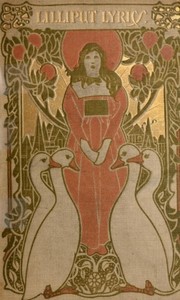
For Lilliput Lyrics — Themes and Context, the stored edition analysis reports 27,929 words, 2 hr 2 min estimated reading time, and 8 detected text sections.
The text analysis averages about 20.1 words per sentence, while the detected sections provide another way to judge how the source is divided.
Project Gutenberg metadata also associates the work with “Children's poetry,” connecting these edition facts with the source record’s subject description.
Explore this collection
These alternatives are selected using recorded categories and estimated reading time.
About 124 minutes
Fantasy Juvenile Worlds
28,378 recorded words. 2 minutes difference from this book's estimate.
View Gutenberg source #1471About 106 minutes
Fantasy Juvenile Worlds
24,379 recorded words. 16 minutes difference from this book's estimate.
View Gutenberg source #6957About 106 minutes
Fantasy Juvenile Worlds
24,270 recorded words. 16 minutes difference from this book's estimate.
View Gutenberg source #9652Search stored excerpts and compare books → Choose by your preferences →
Choices use stored catalog measurements. Estimates vary with reading speed. A shared category is a catalog label, not a claim that two books have the same argument or literary quality.
Search reads excerpt text stored with this catalog and links to its associated Gutenberg record. The connection is stored in the site database; this tool does not recheck that every excerpt is word-for-word identical to that external record. Excerpt search does not cover every chapter and does not verify historical publication dates.
Catalog snapshot checked: 2026-09-26. Coverage: 95 public books, 95 available source excerpts.
Calculated from edition completeness, EPUB availability, text structure and catalogue metadata. Not a user rating.
Total of 100 points, scaled to a 2.5-5.0 range. Editions with an empty description or a missing EPUB file are not scored.
Public-domain source text
The source text is kept in the dedicated reader, separate from this catalogue record and its commentary.
The editor's preface to Lilliput Lyrics immediately signals a hands-on approach: R. Brimley Johnson states he has 'occasionally edited the text, without scruple, by omitting weak lines or even altering a word.' This frank admission frames the entire collection as a curated selection, not a faithful reprint. Johnson explains that the verses were chosen from Rands' earlier Lilliput Levee (1868) and magazine contributions, with the aim of remembering children's 'tastes and understandings.' The preface thus prepares readers for a deliberately shaped anthology, where editorial intervention is part of the reading experience.
The opening pages establish a clear editorial presence. Johnson names his sources—Lilliput Levee, magazines, and a reprint of Lilliput Lectures—and acknowledges permissions from publishers and Rands’ son. This transparency invites readers to consider the collection as a constructed artifact rather than a spontaneous outpouring. The note that many poems 'never received the author’s final revision' further justifies Johnson’s alterations, making the editor a collaborator. For a first reader, this preface is a roadmap: expect polished, selected verses, not raw manuscripts. The inclusion of a contents list with 56 titles (from 'The Pedlar’s Caravan' to 'Mother’s Joy') offers a quick survey of the book’s range, from doll poems to narrative ballads.
The excerpt from 'Shockheaded Cicely and the Two Bears' provides the most extended narrative in the sample. The poem unfolds in three parts, tracing Cicely’s journey from poverty to marriage with Sir Nicholas Hildebrand. Key details ground the story: the town crier’s 'Ding dong! O yes!' summons, the precise time 'three,' and the list of women—'Mary, Margaret, Bridget, Bess'—who dress elaborately. Cicely is distinguished by her 'tossy head' and 'shaggypate,' physical traits that become central to the plot. The bears, brought from the Holy Land, recognize her as 'Related to us' because of her wild hair. The poem’s structure—exclusion, intrusion, recognition, reward—mirrors a fairy-tale logic, but Rands undercuts it with comic details like the bears walking on hind legs and the final moral about keeping hair 'in a proper state.'
Across the excerpts, hair emerges as a repeated symbol. In 'Shockheaded Cicely,' unkempt hair marks low status and later becomes a sign of kinship with bears. The poem ends with a commercial chant: 'Sing bear’s grease! curling-irons to sell! Sing combs and brushes!' This transforms a personal trait into a marketable commodity. Animals also recur: the postman’s knock is likened to 'the Raven in Odin’s ear,' and bears play a central role. Social hierarchies are gently mocked—the ladies faint while Cicely boldly feeds the bears. The editor’s note that Rands wrote 'under many signatures' hints at a playful authorial identity, mirroring the poems’ own games with voice and perspective.
The contents list reveals a mix of forms: doll poems, songs, and narrative verses. Titles like 'The Ship that Sailed into the Sun' and 'The Discontented Yew-Tree' suggest whimsical premises, while 'The Penance of the Little Maid' hints at moral undertones. The excerpted 'Rat-tat! the postman knocks!' frames the collection as a 'Lilliput letter-box,' inviting readers to open each poem as a message. This framing device, combined with the editor’s preface, positions the book as a mediated exchange between author, editor, and child audience. The poems’ short lines and regular rhymes (e.g., 'knocks/box,' 'dear/ear') create a rhythmic predictability that suits oral reading, a likely intended use.
First-time readers of Lilliput Lyrics should attend to the interplay between editorial curation and poetic play. Johnson’s preface is not a mere formality but a key to understanding the text’s construction. The poems reward attention to recurring details—hair, animals, social rituals—that Rands uses to build miniature worlds. Reading aloud may reveal the sonic patterns that make these verses memorable. The collection invites comparison with other Victorian children’s poetry, but its specific charm lies in its blend of nonsense, narrative, and gentle satire.
There’s a particular hush in the editor’s preface to Lilliput Lyrics, a gentle hand guiding a child’s first steps between nonsense and wonder. I recall that same quiet steadiness in the margins of my worn Rose buds — Reading Companion, as if both volumes understood that blossoming requires patience, not haste. They keep each other’s company on my shelf.
Save your reaction, strongest insight, and memorable passage.