About 253 minutes
Matthew Arnold's Sohrab and Rustum, and other poems — Key Ideas to Explore
Science Fiction Utopias
58,007 recorded words. 18 minutes difference from this book's estimate.
View Gutenberg source #13364
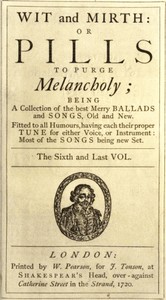
The source record for Wit and Mirth: or Pills to Purge Melancholy, Vol. 6 of 6 — Themes and Context measures this digital text at 53,853 words, 3 hr 55 min estimated reading time, and 13 detected text sections.
The text analysis averages about 29.3 words per sentence, while the detected sections provide another way to judge how the source is divided.
Project Gutenberg metadata also associates the work with “Ballads, English,” connecting these edition facts with the source record’s subject description.
Explore this collection
These alternatives are selected using recorded categories and estimated reading time.
About 253 minutes
Science Fiction Utopias
58,007 recorded words. 18 minutes difference from this book's estimate.
View Gutenberg source #13364About 216 minutes
Science Fiction Utopias
49,627 recorded words. 19 minutes difference from this book's estimate.
View Gutenberg source #12026About 187 minutes
Science Fiction Utopias
42,873 recorded words. 48 minutes difference from this book's estimate.
View Gutenberg source #995Search stored excerpts and compare books → Choose by your preferences →
Choices use stored catalog measurements. Estimates vary with reading speed. A shared category is a catalog label, not a claim that two books have the same argument or literary quality.
Search reads excerpt text stored with this catalog and links to its associated Gutenberg record. The connection is stored in the site database; this tool does not recheck that every excerpt is word-for-word identical to that external record. Excerpt search does not cover every chapter and does not verify historical publication dates.
Catalog snapshot checked: 2026-09-26. Coverage: 95 public books, 95 available source excerpts.
Calculated from edition completeness, EPUB availability, text structure and catalogue metadata. Not a user rating.
Total of 100 points, scaled to a 2.5-5.0 range. Editions with an empty description or a missing EPUB file are not scored.
Public-domain source text
The source text is kept in the dedicated reader, separate from this catalogue record and its commentary.
This sixth volume of Wit and Mirth presents a sequence of songs that move between taverns, streets, and domestic interiors, often using a single tune for multiple lyrics. The collection's structure is shaped by its alphabetical table of songs and the recurring pattern of a tune name followed by its lyric page, creating a practical reference for performance. The excerpts reveal a world where clergymen debate theology in verse, Quakers are satirized for hypocrisy, and Windsor wives defend their honor against London stereotypes.
The volume's organization foregrounds the relationship between music and words. Each entry lists a tune page and a lyric page, implying that the same melody could carry different verses. For instance, the tune for "The Saint turn'd Sinner" is marked "To the foregoing Tune," linking it directly to the preceding song. This pairing suggests that readers or performers were expected to know the melodies or have access to a separate musical score. The repetition of tunes across multiple songs creates a network of intertextual echoes, where a familiar tune could lend irony or emphasis to new lyrics.
Several songs in the excerpts employ images of flight, pursuit, or escape. In "The Battle-Royal," Religion "took her flight" after the disputing clergymen fail to agree. In "The Saint turn'd Sinner," the Quaker woman is "forc'd to call the Watch in" to stop the parson's advances, while the parson himself is described as "more eager / Than lustful Turk or Neger." The Windsor wives assert their independence by declaring they will "sing and laugh" despite being mocked. These recurring motifs of movement—whether literal flight, pursuit, or defiant stasis—give the collection a kinetic quality, as characters shift between roles of aggressor and victim.
Many songs are structured as debates or confrontations. "The Battle-Royal" features a Dean and a Prebendary arguing over who has more grace, with a third figure, the Master of the Charter, denying the existence of God entirely. The song ends with Religion fleeing, leaving the disputants as "Fools a Prating." Similarly, "The Saint turn'd Sinner" presents a dialogue between a Dissenting parson and a Quaker woman, where the parson uses biblical precedent to justify his advances. These dialogues use direct speech and rhetorical questions to dramatize conflicts, often undercutting authority figures by exposing their hypocrisy or absurdity.
The songs frequently reference specific locations and social types. "The Merry Wives of Windsor" contrasts the honesty of Windsor women with the perceived corruption of London's "City Dames" and "Bankside" wenches. Other songs mention "Islington," "London Town," and "Windsor Horn," grounding the lyrics in recognizable places. The collection also includes songs about tradespeople, such as "A Jolly young Grocer of London Town" and "A Taylor good Lord," suggesting a broad social canvas. This attention to local identity and occupational stereotypes gives the volume a documentary quality, reflecting the urban and suburban milieu of early 18th-century England.
Readers approaching this volume should attend to the interplay between tune and text, as the same melody can transform the meaning of different lyrics. The songs reward attention to their dialogic structure and the recurring imagery of flight, pursuit, and social performance. Rather than a unified narrative, the collection offers a mosaic of voices, each vying for attention in a crowded tavern of wit and mirth.
I’ve spent long afternoons with D’Urfey’s volume, chuckling at its bawdy bluster, yet it always left a quiet ache—the way laughter hides a longing for plainness. That ache found its echo in Ye book of Copperheads — Story, Setting & Ideas, whose dry pages hold a similar patience with human folly, though its humor runs darker, closer to embers than sparks.
Answer a few questions and save a private reflection on this device.