About 385 minutes
The Sufistic Quatrains of Omar Khayyam — A Closer Reading
Adventure Picaresque Fiction
88,535 recorded words. 36 minutes difference from this book's estimate.
View Gutenberg source #38511
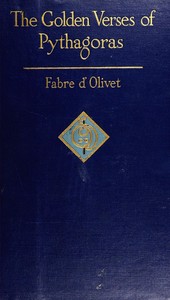
Before opening The golden verses of Pythagoras — Story, Setting & Ideas, the edition data offers a quick orientation: 96,757 words, 7 hr 1 min estimated reading time, and 21 detected text sections.
The text analysis averages about 26.6 words per sentence, while the detected sections provide another way to judge how the source is divided.
Project Gutenberg metadata also associates the work with “Poetry -- History and criticism,” connecting these edition facts with the source record’s subject description.
Explore this collection
These alternatives are selected using recorded categories and estimated reading time.
About 385 minutes
Adventure Picaresque Fiction
88,535 recorded words. 36 minutes difference from this book's estimate.
View Gutenberg source #38511About 324 minutes
Adventure Picaresque Fiction
74,359 recorded words. 97 minutes difference from this book's estimate.
View Gutenberg source #12622About 534 minutes
Adventure Picaresque Fiction
122,725 recorded words. 113 minutes difference from this book's estimate.
View Gutenberg source #32262Search stored excerpts and compare books → Choose by your preferences →
Choices use stored catalog measurements. Estimates vary with reading speed. A shared category is a catalog label, not a claim that two books have the same argument or literary quality.
Search reads excerpt text stored with this catalog and links to its associated Gutenberg record. The connection is stored in the site database; this tool does not recheck that every excerpt is word-for-word identical to that external record. Excerpt search does not cover every chapter and does not verify historical publication dates.
Catalog snapshot checked: 2026-09-26. Coverage: 95 public books, 95 available source excerpts.
Calculated from edition completeness, EPUB availability, text structure and catalogue metadata. Not a user rating.
Total of 100 points, scaled to a 2.5-5.0 range. Editions with an empty description or a missing EPUB file are not scored.
Public-domain source text
The source text is kept in the dedicated reader, separate from this catalogue record and its commentary.
Fabre d'Olivet's Golden Verses of Pythagoras is not a translation alone but a layered commentary that begins with a lengthy discourse on the essence and form of poetry among ancient peoples. The translator, Nayán Louise Redfield, notes in her foreword that d'Olivet received a Pythagorean initiation in 1790, which shaped his later works. The text opens with the Greek maxims Μηδὲν ἄγαν and γνῶθι σεαυτόν, signaling a preoccupation with moderation and self-knowledge that recurs throughout.
Redfield's foreword establishes d'Olivet as a solitary genius whose work was destined for a few devoted followers. She cites Saint Yves d'Alveydre's claim that d'Olivet received his Pythagorean initiation in Germany in 1790, an event that left a profound imprint on his later productions. This biographical detail frames the commentary as the product of an initiated mind, not merely a scholar. The foreword also emphasizes d'Olivet's vast erudition: he mastered Semitic and Aryan languages and even Chinese hieroglyphics during a decade of retirement. Redfield's language—calling the work a “rich Fruit of Wisdom” offered to “Travellers who have turned their Faces to the Dawn”—suggests a spiritual, almost esoteric readership.
D'Olivet's discourse on poetry argues that the Golden Verses are not merely moral precepts but a poetic expression of profound philosophical truths. He contends that ancient poets used verse to encode knowledge about the universe, the soul, and the divine. The commentary repeatedly stresses that the form of poetry—its rhythm, imagery, and structure—is inseparable from its content. For d'Olivet, the Golden Verses exemplify how poetry can convey metaphysical principles, such as the animation of the universe and the uniformity of nature across all scales. This approach treats the text as a living document of Pythagorean thought rather than a historical artifact.
A central argument in the excerpts is that the future is a return of the past and that nature is everywhere alike. D'Olivet explains that this principle of analogy allowed ancient sages to infer the nature of the intelligible sphere from the sentient one. He distinguishes this from later astrological superstition, which he dismisses as “false as ridiculous.” Instead, genethlialogy—the science of reading destiny from the stars—rested on the idea that the point of departure in any sphere could reveal the entire course. D'Olivet supports his claims with references to Chaldean, Egyptian, and Sabæan traditions, citing Stanley, Kircher, and Maimonides. This section reveals his method: synthesizing comparative religion, philology, and philosophy to reconstruct a lost science.
D'Olivet delves into the numerical cycles used by ancient civilizations to measure cosmic time. He notes that the Indians posited a cycle of 4,320,000 years (the Maha-Youg), while the Chinese and Chaldeans reduced it to 432,000 years, and the Egyptians further to 36,000 years—the revolution of the fixed stars. He contrasts these with modern calculations of 25,867 years, highlighting the gap between ancient and contemporary astronomy. This discussion serves to illustrate the limitations of human knowledge: even with such cycles, one could not foresee the return of events with certainty. D'Olivet's tone here is cautious, acknowledging the conjectural nature of such speculations while still presenting them as part of the Pythagorean tradition.
Readers approaching d'Olivet's work should expect a dense, erudite commentary that moves between philology, cosmology, and esoteric philosophy. The text rewards those who attend to its footnotes and cross-references, which ground its claims in a wide array of ancient sources. The Golden Verses themselves are quoted only sparingly in the excerpts, so the focus remains on d'Olivet's interpretive framework rather than the original poem. This edition, with Redfield's translation and foreword, offers a window into early 19th-century occult scholarship and its attempt to revive Pythagorean wisdom.
Reading about Fabre d’Olivet’s search for a hidden unity beneath Pythagoras’s verses, I remembered nights spent with an old, battered songbook, where every bawdy tune felt like a secret handshake with a stranger three centuries gone. That same hush of recognition came from Wit and Mirth: or Pills to Purge Melancholy, Vol. 5 of 6 — Text and Context, each comic stanza a quiet proof that joy, too, was once a careful philosophy.
Your answers remain private and are stored only in this browser.