About 75 minutes
Debris Selections from Poems — Reading Companion
Adventure Picaresque Fiction
17,108 recorded words. 0 minutes difference from this book's estimate.
View Gutenberg source #16108
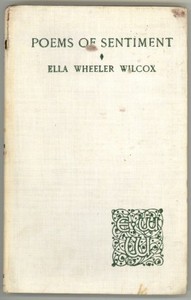
The catalog record for Poems of Sentiment — Themes and Context provides practical reading context through 17,116 words, 1 hr 15 min estimated reading time, and 3 detected text sections.
The text analysis averages about 24.2 words per sentence, while the detected sections provide another way to judge how the source is divided.
Project Gutenberg metadata also associates the work with “American poetry,” connecting these edition facts with the source record’s subject description.
Explore this collection
These alternatives are selected using recorded categories and estimated reading time.
About 75 minutes
Adventure Picaresque Fiction
17,108 recorded words. 0 minutes difference from this book's estimate.
View Gutenberg source #16108About 71 minutes
Adventure Picaresque Fiction
16,252 recorded words. 4 minutes difference from this book's estimate.
View Gutenberg source #1042About 71 minutes
Adventure Picaresque Fiction
16,214 recorded words. 4 minutes difference from this book's estimate.
View Gutenberg source #10750Search stored excerpts and compare books → Choose by your preferences →
Choices use stored catalog measurements. Estimates vary with reading speed. A shared category is a catalog label, not a claim that two books have the same argument or literary quality.
Search reads excerpt text stored with this catalog and links to its associated Gutenberg record. The connection is stored in the site database; this tool does not recheck that every excerpt is word-for-word identical to that external record. Excerpt search does not cover every chapter and does not verify historical publication dates.
Catalog snapshot checked: 2026-09-26. Coverage: 95 public books, 95 available source excerpts.
Calculated from edition completeness, EPUB availability, text structure and catalogue metadata. Not a user rating.
Total of 100 points, scaled to a 2.5-5.0 range. Editions with an empty description or a missing EPUB file are not scored.
Public-domain source text
The source text is kept in the dedicated reader, separate from this catalogue record and its commentary.
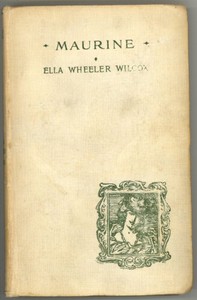
Ella Wheeler Wilcox's Poems of Sentiment (1919) moves through a series of tightly structured narratives that often hinge on a single, charged image. The opening poem, “Double Carnations,” establishes a pattern: a wild Pink and a rich Carnation are separated by a gardener’s trellis, only to be united by a priestly bee. The poem’s floral allegory—complete with a “Mamma Moss” who sleeps while the marriage is performed—introduces a world where natural and social orders collide, and where the boundary between the literal and the symbolic is deliberately blurred.
Throughout the collection, Wilcox returns to a small set of images that anchor her moral and emotional arguments. Flowers appear not only in “Double Carnations” but also in poems like “Two Roses” and “The Little White Hearse,” where they serve as markers of innocence, class, or transience. Light—often described as a hearth-fire, a star, or a ray—frequently signals lost or desired states: in “An Erring Woman’s Love,” the protagonist sees “the hearth-light of the might-have-been” as a distant, unattainable glow. Mirrors and reflective surfaces also recur: the erring woman “gazed in the mirror, spoke her name / And hissed a word that told her shame,” using the mirror as a site of self-confrontation. These images are not merely decorative; they carry the weight of the poem’s central conflict, often appearing at moments of crisis or revelation.
Wilcox frequently shifts the reader from a close, domestic scene to a broader, almost cosmic perspective. In “An Erring Woman’s Love,” the narrative begins in a private room—a woman alone with a mirror—then expands to a dream of a vine-wreathed cottage and a family tableau, before contracting again to the woman’s waking despair. This oscillation between interior and exterior spaces mirrors the poem’s thematic tension between personal guilt and social judgment. Similarly, “The Watcher” and “Life’s Track” move from individual observation to generalized reflection, as if the speaker is stepping back from a single life to consider the pattern of all lives. The effect is a kind of moral zoom lens: the reader is pulled close to a character’s specific pain, then pushed back to see the larger forces at work.
The poems in this collection are built on a clear, often symmetrical structure that reinforces their didactic intent. Many follow a pattern of problem, crisis, and resolution—or, in darker poems, a descent without recovery. “Double Carnations” uses a four-stanza narrative arc: introduction of lovers, obstacle, intervention, and triumphant conclusion. “An Erring Woman’s Love” is more complex, moving through a series of emotional stages—shame, prayer, dream, despair, and a final, ambiguous preparation for death—that mirror the stages of a moral awakening. The repeated use of direct address (“O God,” “Dear heart”) and the insertion of a child’s prayer (“Now I lay me down to sleep”) create a rhythmic structure that feels both liturgical and intimate. This careful architecture suggests that Wilcox saw poetic form as a vehicle for moral instruction, with each stanza advancing a step in a spiritual argument.
One of the most striking features of the collection is its treatment of the divided self, particularly in relation to gender. In “An Erring Woman’s Love,” Wilcox explicitly contrasts male and female experience: “Man’s dual selves seem separate; / He leaves his soul outside sin’s gate… / But woman, far more complicate, / Can take no chances with her fate; / A subtle creature, finely spun, / Her body and her soul are one.” This passage, which appears near the poem’s climax, crystallizes a recurring concern: the impossibility of compartmentalization for women. The speaker’s voice shifts between third-person narration and direct interior monologue, creating a sense of psychological depth that is rare in the more allegorical poems. The use of a child’s prayer and the dream sequence further blurs the line between conscious and unconscious thought, suggesting that the poem’s true drama is internal.
Readers approaching Poems of Sentiment will find a collection that rewards attention to its structural patterns and recurring images. Wilcox’s poems often begin with a concrete object or scene—a flower, a mirror, a child’s prayer—and then expand into moral reflection. The movement between intimate detail and broad statement is the collection’s defining formal feature. Rather than looking for a single narrative thread, consider how each poem reworks the same emotional material: the tension between desire and duty, the weight of memory, and the possibility of redemption. The excerpts suggest a poet deeply engaged with the craft of moral storytelling, using repetition and variation to explore a narrow but intense range of human experience.
I was rereading the notes on Poems of Sentiment today, the way those domestic scenes quietly widen into something larger. It reminded me, strangely, of sitting with The Dreamers And Other Poems — Themes and Context—same gentle pull between the personal and the vast. Both feel like rooms with unexpectedly open windows, light falling across familiar things until they seem almost new.
Save your reaction, strongest insight, and memorable passage.