About 421 minutes
The golden verses of Pythagoras — Story, Setting & Ideas
Adventure Picaresque Fiction
96,757 recorded words. 36 minutes difference from this book's estimate.
View Gutenberg source #69174
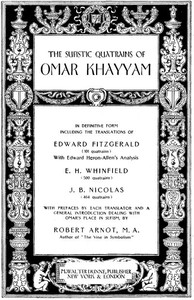
For The Sufistic Quatrains of Omar Khayyam — A Closer Reading, the stored edition analysis reports 88,535 words, 6 hr 25 min estimated reading time, and 21 detected text sections.
The text analysis averages about 19.8 words per sentence, while the detected sections provide another way to judge how the source is divided.
Project Gutenberg metadata also associates the work with “FitzGerald, Edward, 1809-1883,” connecting these edition facts with the source record’s subject description.
Explore this collection
These alternatives are selected using recorded categories and estimated reading time.
About 421 minutes
Adventure Picaresque Fiction
96,757 recorded words. 36 minutes difference from this book's estimate.
View Gutenberg source #69174About 324 minutes
Adventure Picaresque Fiction
74,359 recorded words. 61 minutes difference from this book's estimate.
View Gutenberg source #12622About 534 minutes
Adventure Picaresque Fiction
122,725 recorded words. 149 minutes difference from this book's estimate.
View Gutenberg source #32262Search stored excerpts and compare books → Choose by your preferences →
Choices use stored catalog measurements. Estimates vary with reading speed. A shared category is a catalog label, not a claim that two books have the same argument or literary quality.
Search reads excerpt text stored with this catalog and links to its associated Gutenberg record. The connection is stored in the site database; this tool does not recheck that every excerpt is word-for-word identical to that external record. Excerpt search does not cover every chapter and does not verify historical publication dates.
Catalog snapshot checked: 2026-09-26. Coverage: 95 public books, 95 available source excerpts.
Calculated from edition completeness, EPUB availability, text structure and catalogue metadata. Not a user rating.
Total of 100 points, scaled to a 2.5-5.0 range. Editions with an empty description or a missing EPUB file are not scored.
Public-domain source text
The source text is kept in the dedicated reader, separate from this catalogue record and its commentary.
This volume assembles three distinct English translations of Omar Khayyam's quatrains, each accompanied by its own preface and notes, creating a layered editorial conversation about how a medieval Persian mathematician-poet was received in the West. Edward FitzGerald's 101 quatrains, presented in their first-edition form, sit alongside E.H. Whinfield's 500-quatrain version and J.B. Nicolas's prose translation from French. The juxtaposition immediately exposes how translation choices—from the number of quatrains selected to the decision to render in verse or prose—profoundly alter the texture and implied meaning of the rubaiyat.
The most striking feature of this edition is its refusal to present a single authoritative Khayyam. FitzGerald's famous quatrains, with their tight quatrain form and memorable epigrams, are immediately followed by Whinfield's more expansive collection, which includes extensive footnotes tracing variant readings and allusions to Islamic theology. Nicolas's prose version, translated from French, offers yet another register—more explanatory, less lyrical. The reader can compare, for instance, how FitzGerald's 'Drink wine to root up metaphysic weeds' (quatrain 194) becomes in Whinfield a more literal rendering with a footnote citing Muhammad's saying about seventy-three sects. This editorial structure forces attention to the translator's hand rather than treating the text as transparent.
The apparatus in this volume does not merely clarify; it shapes interpretation. Whinfield's footnotes frequently reference Persian grammar, variant manuscripts, and Islamic sources—for example, explaining that a 'triple divorce is irrevocable' (Koran ii. 230) in a quatrain about divorcing 'old faith and reason.' Edward Heron-Allen's analysis of FitzGerald's fifth edition provides a systematic quatrain-by-quatrain breakdown, tracing sources and alterations across editions. The result is a scholarly layer that insists on the quatrains' embeddedness in Persian literary and religious traditions, counterbalancing FitzGerald's more universalizing, romanticized version. Readers encounter not just poetry but a debate about how much cultural context is necessary for understanding.
Across the translations, certain motifs recur with telling variations. Wine appears both as literal drink and as metaphor for divine intoxication, with translators diverging on how explicitly to signal the Sufi allegorical reading. The 'potter' and 'clay' imagery (the Kuza-Nama section) is handled differently: FitzGerald's version emphasizes existential fragility, while Whinfield's notes connect it to Persian ceramic traditions. The figure of the 'cupbearer' (saki) oscillates between a human servant and a divine intermediary. These recurring elements, visible across the three translations, allow the reader to track how each translator navigates the tension between literal and mystical interpretation—a tension that the editorial framing deliberately highlights rather than resolves.
Rather than reading straight through, consider comparing a single quatrain across all three versions, noting differences in word choice, line length, and explanatory notes. This volume rewards nonlinear exploration: the indexes, comparative tables, and Heron-Allen's analysis invite cross-referencing. Pay particular attention to the footnotes, where translators reveal their assumptions about what a reader needs to know—and what they choose to leave implicit.
Holding this edition, I recalled sitting alone with FitzGerald’s rendering, feeling the ache of time’s impermanence. That same hush returned while reading Primavera—not the verses themselves, but the ghost of a translator’s hand, shaping another’s grief into something almost bearable. Each page felt like a borrowed breath, a quiet friend nodding across centuries. Primavera: Poems by Four Authors — Themes and Context stirred that identical, tender solitude.
Answer a few questions and save a private reflection on this device.