About 204 minutes
Poems of the Heart and Home — Text and Context
Adventure Picaresque Fiction
46,805 recorded words. 21 minutes difference from this book's estimate.
View Gutenberg source #6621
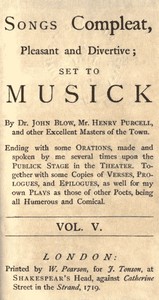
The catalog record for Wit and Mirth: or Pills to Purge Melancholy, Vol. 5 of 6 — Text and Context provides practical reading context through 51,742 words, 3 hr 45 min estimated reading time, and 12 detected text sections.
The text analysis averages about 31.0 words per sentence, while the detected sections provide another way to judge how the source is divided.
Project Gutenberg metadata also associates the work with “Ballads, English,” connecting these edition facts with the source record’s subject description.
Explore this collection
These alternatives are selected using recorded categories and estimated reading time.
About 204 minutes
Adventure Picaresque Fiction
46,805 recorded words. 21 minutes difference from this book's estimate.
View Gutenberg source #6621About 202 minutes
Adventure Picaresque Fiction
46,234 recorded words. 23 minutes difference from this book's estimate.
View Gutenberg source #11091About 173 minutes
Adventure Picaresque Fiction
39,671 recorded words. 52 minutes difference from this book's estimate.
View Gutenberg source #7796Search stored excerpts and compare books → Choose by your preferences →
Choices use stored catalog measurements. Estimates vary with reading speed. A shared category is a catalog label, not a claim that two books have the same argument or literary quality.
Search reads excerpt text stored with this catalog and links to its associated Gutenberg record. The connection is stored in the site database; this tool does not recheck that every excerpt is word-for-word identical to that external record. Excerpt search does not cover every chapter and does not verify historical publication dates.
Catalog snapshot checked: 2026-09-26. Coverage: 95 public books, 95 available source excerpts.
Calculated from edition completeness, EPUB availability, text structure and catalogue metadata. Not a user rating.
Total of 100 points, scaled to a 2.5-5.0 range. Editions with an empty description or a missing EPUB file are not scored.
Public-domain source text
The source text is kept in the dedicated reader, separate from this catalogue record and its commentary.
The volume opens with an alphabetical table of songs and poems, immediately signaling its nature as a miscellany meant for browsing rather than linear reading. The first song, 'All Christians and Lay-Elders too,' sets a tone of irreverent humor, while the inclusion of music notation and midi files reminds us these were performed pieces. D'Urfey's editorial hand is light; he collects rather than annotates, letting the songs speak for themselves.
The excerpts reveal a range of registers: from the pastoral 'Knotting Song' by Sir Charles Sydney to the crude 'Oyster Nan' and the political rant 'The French King in a foaming Passion.' This variety is the collection's organizing principle, and readers should expect abrupt shifts in tone and subject.
The song 'The French King in a foaming Passion' is a clear example of how D'Urfey's collection engages with current events. It lampoons Louis XIV after Marlborough's victories, using a mock-heroic voice: 'Old Lewis le Grand, / He raves like a Fury.' The refrain 'Great Marlborough Conquers' is repeated with ironic glee. The song lists specific grievances—'Towns, Castles, are taken'—and ends with a plea for a cordial. This is not timeless poetry but topical propaganda, meant to amuse an English audience familiar with the War of the Spanish Succession.
Other political songs likely follow similar patterns, though the excerpts only show this one. Readers should note how D'Urfey blends news with entertainment, a common practice in ballad collections of the period.
Several songs explore romantic and sexual themes with varying degrees of subtlety. 'The Knotting Song' uses a pastoral setting: 'Hears not my Phillis how the Birds / Their feather'd Mates salute.' The refrain 'Phillis without a frown or smile, / Sat & knotted' suggests a coy or indifferent beloved. In contrast, the anonymous 'A Bonny Lad came to the Court' and 'As Oyster Nan stood by her T[ub]' are bawdier, with double entendres and rustic characters.
The song 'Would you be a Man in Fashion?' advises taking 'a little Dram of Passion / In a lusty Dose of Wine,' blending carpe diem with drinking culture. These pieces show the collection's range from refined wit to crude humor, often within the same page.
The volume's title page boasts that songs are 'Set to Musick By Dr. John Blow, Mr. Henry Purcell, and other Excellent Masters.' The excerpts include music notation and links to midi files, indicating that the e-book preserves the performative aspect. The 'Knotting Song' is attributed to Sir Charles Sydney, suggesting courtly origins, while others are anonymous or attributed to D'Urfey himself.
The typography preserves archaic spellings ('VV' for 'W') and uses bold italics for blackletter font in the first song. This attention to textual detail helps modern readers experience the original print layout, though the 1876 reprint modernized music notation. The inclusion of 'Orations made and spoken by me several times upon the Publick Stage' hints that D'Urfey was a performer as well as editor.
The alphabetical table of contents lists songs by first line, a practical choice for a collection meant to be dipped into. The excerpts show that songs vary in length from short lyrics to longer narrative pieces. The volume ends with legal boilerplate from Project Gutenberg, but the original likely concluded with more songs or D'Urfey's orations.
Readers should use the table to find specific pieces, but the lack of thematic grouping means serendipity plays a role. The mixture of genres—ballads, songs, poems, orations—suggests D'Urfey intended the book for leisurely consumption, perhaps at social gatherings where music was performed.
Approach this volume as a sampler of early 18th-century popular culture, not a unified work. The songs reward attention to historical context, wordplay, and musical setting. Let the alphabetical table guide you, but allow room for unexpected discoveries. The political satire gains bite when read alongside Marlborough's campaigns; the love songs reflect courtly and rustic traditions. D'Urfey's collection is a window into the humor and concerns of its time.
There’s a particular glow to old comic tunes that lingers, long after the raucousness fades. Reading D’Urfey’s bawdy verses, I found myself thinking not of the laughter’s echo, but of the quiet feeling beneath it all—the ache for tenderness that satire so often hides. That softer pulse led me back to Poems of Sentiment — Themes and Context the way one might return to a familiar, gentle window after a storm.
Build a private reading journal entry for this title.