About 111 minutes
Poems, Vol. IV — A Closer Reading
Science Fiction Utopias
25,523 recorded words. 1 minutes difference from this book's estimate.
View Gutenberg source #19109
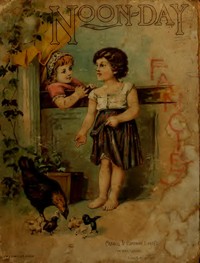
Before opening Noon-Day Fancies for Our Little Pets Fully Illustrated — A Reader’s Guide, the edition data offers a quick orientation: 25,128 words, 1 hr 50 min estimated reading time, and 7 detected text sections.
The text analysis averages about 13.4 words per sentence, while the detected sections provide another way to judge how the source is divided.
Project Gutenberg metadata also associates the work with “Children's poetry,” connecting these edition facts with the source record’s subject description.
Explore this collection
These alternatives are selected using recorded categories and estimated reading time.
About 111 minutes
Science Fiction Utopias
25,523 recorded words. 1 minutes difference from this book's estimate.
View Gutenberg source #19109About 114 minutes
Science Fiction Utopias
26,013 recorded words. 4 minutes difference from this book's estimate.
View Gutenberg source #11215About 114 minutes
Science Fiction Utopias
26,129 recorded words. 4 minutes difference from this book's estimate.
View Gutenberg source #76646Search stored excerpts and compare books → Choose by your preferences →
Choices use stored catalog measurements. Estimates vary with reading speed. A shared category is a catalog label, not a claim that two books have the same argument or literary quality.
Search reads excerpt text stored with this catalog and links to its associated Gutenberg record. The connection is stored in the site database; this tool does not recheck that every excerpt is word-for-word identical to that external record. Excerpt search does not cover every chapter and does not verify historical publication dates.
Catalog snapshot checked: 2026-09-26. Coverage: 95 public books, 95 available source excerpts.
Calculated from edition completeness, EPUB availability, text structure and catalogue metadata. Not a user rating.
Total of 100 points, scaled to a 2.5-5.0 range. Editions with an empty description or a missing EPUB file are not scored.
Public-domain source text
The source text is kept in the dedicated reader, separate from this catalogue record and its commentary.
This collection of short poems and stories, edited by Oscar M. Dunham and first published in 1888, offers a window into late-nineteenth-century childhood. The pieces are brief, often ending with a clear moral or practical lesson, and they revolve around everyday domestic and rural settings. Animals—kittens, dogs, ducks, and even a pet fox—appear frequently, sometimes as companions and sometimes as sources of trouble. The tone is consistently instructive yet light, with a strong emphasis on obedience, kindness, and learning from mistakes.
The excerpts reveal a recurring pattern: a child’s well-meaning plan goes awry due to ignorance or impulsiveness, leading to a gentle correction. In “Kitty’s Basket Ride,” a kitten climbs a trellis and must be rescued; in “Making Maple Sugar,” two boys tap a birch tree in autumn instead of a maple in spring; and in “Weezy’s Sambo,” a doll is accidentally taken into the street. These episodes share a structure of mishap followed by adult intervention or natural consequence, suggesting that the book’s primary aim is to teach through entertaining example.
Across the excerpts, a clear narrative pattern emerges: a child or animal acts on incomplete knowledge, encounters a problem, and is then set right by an older figure or by circumstance. In “Kitty’s Basket Ride,” the kitten climbs too high and is rescued by a child using a basket on a pole. In “Making Maple Sugar,” John and Tim tap a birch tree in the wrong season, and Miss Smith explains their error. In “Weezy’s Sambo,” the doll is tied to a coat button and inadvertently taken outside, causing public laughter. Each story builds tension through the character’s limited perspective, then resolves with a lesson.
This pattern is not merely repetitive; it reinforces the book’s didactic purpose. The child characters are never punished harshly—instead, they are corrected with patience or left to feel foolish. The kitten is safely brought down, the boys are “sadder and wiser,” and Weezy’s doll is eventually retrieved (the excerpt cuts off before the resolution, but the tone suggests a harmless outcome). The emphasis is on learning through experience rather than through scolding.
Everyday household items take on surprising functions in these stories. In “Kitty’s Basket Ride,” a basket tied to a pole becomes a rescue device. In “Making Maple Sugar,” a nail and hammer substitute for a gimlet, and a pint kettle serves as a sap collector. In “Weezy’s Sambo,” a coat button becomes an anchor for a doll’s scarf, and the overcoat itself turns into a vehicle for unintended comedy. These transformations highlight the resourcefulness—and sometimes the folly—of the characters.
The objects are not merely props; they drive the plot. The basket enables the rescue, the nail creates the hole, the button causes the doll to be carried away. This focus on tangible, familiar items grounds the stories in a world children would recognize. The illustrations, mentioned in the title, likely reinforced this visual connection between objects and their uses. The text thus encourages readers to see ordinary things as tools for problem-solving or as potential sources of mishap.
The dialogue in the excerpts reveals a contrast between the confident, often mistaken assertions of children and the calm corrections of adults. In “Making Maple Sugar,” Tim exclaims, “I thought it would be full of maple sugar, all ready to eat!” and John replies with a condescending “You don’t know much.” Later, Miss Smith gently points out that they have tapped a birch, not a maple, and that it is the wrong season. The children’s voices are full of excitement and certainty, while the adults speak with factual authority.
In “Weezy’s Sambo,” the child’s speech is rendered in a playful, ungrammatical style: “What for Sambo run away and hide?” and “Now mamma mus’ tie Sambo.” This imitation of a toddler’s language adds authenticity and humor. The adult characters, like Papa Haynes, are largely silent or react with bewilderment. The narrative voice itself is omniscient and slightly amused, describing the doll “bobbing up and down” and the laughing schoolchildren. This narrative stance aligns the reader with the amused observer rather than the child protagonist, reinforcing the lesson that childish schemes often appear funny to grown-ups.
Readers approaching this collection should expect short, self-contained pieces that reward attention to detail. The moral lessons are embedded in concrete situations rather than abstract maxims, and the humor arises from the gap between a child’s intention and the outcome. The book’s structure—a series of independent stories and poems—makes it suitable for reading aloud or for young readers building stamina. The illustrations, though not reproduced here, likely complement the text’s focus on expressive animals and expressive children. This is a book that invites readers to notice how small mistakes can lead to bigger lessons, and how everyday objects can become part of a story.
I remember afternoons spent within the sunny domestic chaos of Noon-Day Fancies, where a child’s spilled milk became a moral lesson. It always brings to mind the quieter, more threadbare ache of new poems I later shelved—the same heart, grown older. There’s a gentle lineage between them. Poems New and Old — Context and Discussion holds that echo, like hearing a tune hummed much later in a colder room.
Answer a few questions and save a private reflection on this device.