A Humorous History of England — Key Ideas to Explore

(0 User reviews)   350
Harrison, Charles, -1943 Project Gutenberg 2008 Not confirmed
Caricatures and cartoons -- Great Britain; English wit and humor; Humorous poetry; Great Britain -- History -- Humor Readers of public-domain and historical texts
Project Gutenberg digital edition en

Edition facts

Words 11,434
Reading time 50 min
Text sections 4

Before opening A Humorous History of England — Key Ideas to Explore, the edition data offers a quick orientation: 11,434 words, 50 min estimated reading time, and 4 detected text sections.

The text analysis averages about 20.2 words per sentence, while the detected sections provide another way to judge how the source is divided.

Project Gutenberg metadata also associates the work with “Caricatures and cartoons -- Great Britain,” connecting these edition facts with the source record’s subject description.

A verse-and-cartoon chronicle of English history from prehistoric times through Queen Anne, using anachronistic jokes, irregular meter, and digressive advertisements to satirize both the past and early 20th-century Britain.
Share
Editorial Edition Score 4.5/5

Calculated from edition completeness, EPUB availability, text structure and catalogue metadata. Not a user rating.

How this score is calculated
  • Description quality20 pts
  • Title & short description10 pts
  • Source metadata20 pts
  • Text length15 pts
  • Chapters / structure15 pts
  • EPUB file integrity20 pts

Total of 100 points, scaled to a 2.5-5.0 range. Editions with an empty description or a missing EPUB file are not scored.

Edition quality

Read the Text

And did a lot of useful things; Built Oxford with its noble spires And mapped out England into Shires.

Danes In seven-eight-three first came the Danes 783 Who caused the Saxons aches and pains. They sailed right up our rivers broad, Putting the natives to the sword. "Danegeld" For centuries our sadly fated 991 Towns by them were devastated. Etheldred the 'Unready Toff' By 'Danegeld' tries to buy them off.

Canute Two hundred years the raiding Danes 1014-1036 Came over. Then their Canute reigns. We'll merely mention that he tried An object lesson with the tide. Hardicanute Hardicanute, sad to confess, 1039-1041 Died from drinking to excess. He couldn't conquer love of wine And with him went the Danish line.

Edward Edward the Confessor staid the Confessor The Saxon line renewed. Remade 1041-1066 At Westminster the Abbey grand, And signed the first 'Will' in this land. And since his time ('tis not refuted) Scores of Wills have been disputed. Ah! legal quibbles such as these Mean Lawyers waxing rich on fees.

Harold Harold last of the Saxon line 1066 At Hastings made an effort fine And lost his life--it was to be, Crushed by the men of Normandy. From Scandinavia they'd come, And made fair Normandy their home; William the Whence William spying out our shore, Conqueror Oliver-Twist-like, wanted more. 1066-1087 In ten-six-six he won the day In that tough fight out Hastings way. Of course, no record in our reach, Depicts 'ole Bill' thus on the beach.

William the But one thing's certain. Camera men, Conqueror If only they'd existed then, 1066-1087 Would have journeyed many a mile To 'snap' King William's happy smile. They made him King and schoolbooks say He ruled with arbitrary sway; Demanding with sharp battle axes Instant payment of big taxes. Curfew And p'raps it's just as well to tell He introduced the Curfew Bell; So at the early hour of eight Each doused his glim, raked out his grate. In bed at eight P.M. each day Life was but sombre, dull and grey; No cutting fancy ball room capers, No Cinemas or evening papers. He was a bully it is true, But to allow him his just due He made reforms; he also took In hand the bulky Doomsday book.

In William's time we're glad to write People began to be polite; Ladies curtseyed to their beaux, Who smartly raised their gay chapeaux. The Jews The Jews he introduced from Spain Bringing much knowledge in their train Of Arts and Science; but 'Longshanks' Expelled them with no word of thanks. Feudalism These were the well known Feudal days, Tenants were slaves in many ways To mighty Lords who owned the land And ruled them with an iron hand. Not free from duties were the Lords, The King could call upon their swords And men to fight in time of need. So feudal laws of old decreed.

William Rufus William Rufus or the 'Red' 1087-1100 In ten-eight-seven ruled instead; This may be; but we know, alack, Though he was red his deeds were black. Crusades The first Crusade in ten-nine-five, 1095 A million men, a very hive, Swarm to the East, the Holy plain From the Mohammedans to gain.

Henry I. Henry the First, of wisdom rife, 1100-1135 Saxon Matilda makes his wife, Saxon and Norman line uniting, A learned chap who loved not fighting.

Stephen Stephen of Blois ascends the throne 1135-115 And 'gainst Matilda holds his own; Grandson of the Conqueror; Died in eleven-fifty-four.

Henry II. Henry the Second claims our rhyme 1154-1189 'The hardest worker of his time'; A wiser King we never had Nor father with his sons so bad. Becket This the first 'Plantagenet' King With Becket strove like anything; Church v. Which should be Master, Church or Crown Crown Pull-King Pull-Bishop; both went down. Thomas was murdered by four Knights On steps of Altar--Sorry wights: With bleeding feet the King atones By pilgrimage to Becket's bones. Despite his struggles with the Church He knocked the barons off their perch, Fifteen hundred Castles razing In a manner quite amazing. Law Trial by jury further grows; The King's Court in this reign arose; Our Parliaments from this proceed And all our other Courts indeed. Linen Linen's first used in twelve-five Woollens alone in vogue before. Glass Windows In eleven-eight-nought first came to pass The novelty of window glass. And doubtless playful little boys Full of children's simple joys, Cracked as our youngsters often do With stones or ball a pane or two. Richard Coeur de Lion from one Crusade Coeur de Lion Returning was a prisoner made. 1189-1199 But Blondel played an Air he knew, The King joined in; Voila the clue. This catchy tune in a pleasant key Opened the door to liberty.

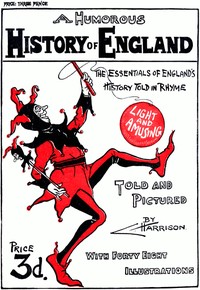
Charles Harrison’s A Humorous History of England (1920) is a rhymed, illustrated gallop through English history, from prehistoric “dug-outs in the rocks” to Queen Anne. The book’s tone is set early: the preface announces “lighter vein” and puns on “pastures (Green’s)”—a wink at the historian J.R. Green. Harrison’s diction mixes colloquial bluntness (“cracked a skull or two per day”) with mock-heroic formality, while his meter often strains for a rhyme, creating a deliberate amateurishness that undercuts any pretense of scholarly authority.

Meter, Rhyme, and Deliberate Awkwardness

Harrison writes in rhyming couplets of irregular length, frequently forcing a rhyme at the expense of natural word order. For example, describing the Druids: “Ancient Druids, holding sway / By smattering of Occult law / And man’s eternal sense of awe.” The line “By smattering of Occult law” is syntactically odd—it reads as a noun phrase rather than a clause—suggesting the rhyme with “awe” dictated the phrasing. Similarly, “He joined in little feuds no doubt” uses the filler “no doubt” to complete the meter. These choices give the verse a doggerel quality that aligns with the book’s humorous intent, as if the author is more interested in a punchline than prosody.

Anachronism and Modern Jabs

Harrison peppers his historical narrative with anachronistic references and contemporary digs. In the section on Charles II, he quotes the king’s famous retort—“My words my own / My acts my ministers’ alone”—then immediately pivots to the hearth tax: “citizens who couldn’t pay / Shivered and grumbled as to-day.” The phrase “as to-day” yokes 17th-century grievances to early 20th-century tax complaints. Later, after describing the National Debt’s origin in 1694, Harrison inserts a promotional couplet for Iron Jelloids: “Another National Debt we owe / To Iron Jelloids which the foe / Depression’s worries keep at bay.” This jarring shift from history to patent medicine advertisement is a recurring structural joke, treating the commercial interlude as part of the historical record.

Visual and Typographic Humor

The book’s humor extends beyond verse to its visual elements. The front matter includes a full-page advertisement for “Iron Jelloids” with medical claims about anemia, complete with a testimonial-style layout. This ad is not a separate insert but part of the book’s preliminary pages, blurring the line between content and commerce. Within the historical poems, Harrison uses parenthetical asides and italicized names (e.g., “Habeas Corpus / 1679”) as if footnoting a textbook. The poem on William III ends with a couplet about hanging burglars, referencing “Bill Sykes” from Dickens—a literary allusion that assumes reader familiarity with Oliver Twist. These choices suggest the book expects an audience literate in both history and popular culture.

Selective Emphasis and Omission

Harrison’s coverage is uneven, reflecting his satirical priorities. The Commonwealth section dwells on Cromwell’s conflicts with Parliament—“He made things lively we infer / Frequently at Westminster”—and the famous door-locking incident, but skips the Protectorate’s religious policies. The Restoration gets more space, including details on Charles II’s mistresses, the Great Plague, and the Fire of London, yet the Glorious Revolution is dispatched in four lines. The poem on James II focuses on the Seven Bishops’ trial, omitting the broader political context. These choices suggest Harrison is less interested in balanced history than in episodes that yield easy jokes or contemporary parallels, such as tax resistance or executive overreach.

Harrison’s Humorous History is best read as a period piece of early 20th-century humor, where anachronism and commercial intrusion are part of the joke. Readers should note the interplay between verse and advertisement, and how the author’s irregular meter signals a playful irreverence toward historical authority. The book rewards attention to its deliberate awkwardness and the cultural references embedded in its rhymes.

This book’s rambling verses reminded me of rainy afternoons at my grandmother’s, where laughter came from odd rhymes rather than tidy lessons. It felt familiar, almost like the gentle chaos in Very Short Stories and Verses For Children — Context and Discussion, where playfulness hides a quiet wisdom. I remember turning pages slowly, smiling at the nonsense that somehow made sense of things.

There are no reviews for this eBook.

0
0 out of 5 (0 User reviews )

Add a Review

Your Rating *
There are no comments for this eBook.

Reader reflection

How will you remember this book?

Save your reaction, strongest insight, and memorable passage.

Your progress 0 / 10
1

Have you finished this book?

2

Did this book hold your interest?

3

Would you pass this book on to a friend?

4

Did the language feel accessible?

Related eBooks