About 44 minutes
Ballads of Peace in War — A Reader’s Guide
Historical Psychological Social Fiction
10,003 recorded words. 4 minutes difference from this book's estimate.
View Gutenberg source #3305
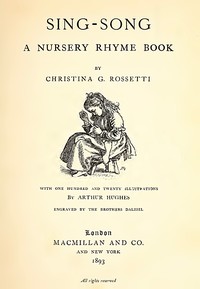
The catalog record for Sing-song — Edition Insights provides practical reading context through 9,187 words, 40 min estimated reading time, and 2 detected text sections.
The text analysis averages about 20.4 words per sentence, while the detected sections provide another way to judge how the source is divided.
Project Gutenberg metadata also associates the work with “Children's poetry, English,” connecting these edition facts with the source record’s subject description.
Explore this collection
These alternatives are selected using recorded categories and estimated reading time.
About 44 minutes
Historical Psychological Social Fiction
10,003 recorded words. 4 minutes difference from this book's estimate.
View Gutenberg source #3305About 33 minutes
Historical Psychological Social Fiction
7,404 recorded words. 7 minutes difference from this book's estimate.
View Gutenberg source #42543About 50 minutes
Historical Psychological Social Fiction
11,317 recorded words. 10 minutes difference from this book's estimate.
View Gutenberg source #4331Search stored excerpts and compare books → Choose by your preferences →
Choices use stored catalog measurements. Estimates vary with reading speed. A shared category is a catalog label, not a claim that two books have the same argument or literary quality.
Search reads excerpt text stored with this catalog and links to its associated Gutenberg record. The connection is stored in the site database; this tool does not recheck that every excerpt is word-for-word identical to that external record. Excerpt search does not cover every chapter and does not verify historical publication dates.
Catalog snapshot checked: 2026-09-26. Coverage: 95 public books, 95 available source excerpts.
Calculated from edition completeness, EPUB availability, text structure and catalogue metadata. Not a user rating.
Total of 100 points, scaled to a 2.5-5.0 range. Editions with an empty description or a missing EPUB file are not scored.
Public-domain source text
The source text is kept in the dedicated reader, separate from this catalogue record and its commentary.
Christina Rossetti's Sing-Song opens with a table of contents that reads like a list of small, vivid moments: 'A baby's cradle with no baby in it,' 'A city plum is not a plum,' 'A diamond or a coal?' These titles immediately signal the book's method—taking ordinary objects and turning them into questions or puzzles. The first poem, 'A baby's cradle with no baby in it,' establishes a tone of gentle melancholy that recurs throughout the collection. Rossetti's voice is direct and unadorned, yet she often undercuts simplicity with a twist: a diamond is preferred in summer, but coal becomes valuable 'what time the waters freeze.' The poems are short, many only four to eight lines, and they rely on rhythm and rhyme to create a lullaby-like cadence. Arthur Hughes's illustrations, engraved by the Brothers Dalziel, complement the text with detailed, often tender images of children, animals, and natural scenes.
Several poems in Sing-Song function as riddles that challenge a child's expectations. 'A pin has a head, but has no hair' lists objects with human features—a clock with a face, a table with legs—but denies them life. 'A diamond or a coal?' presents a choice that shifts with context: in summer, the diamond sparkles; in winter, the coal provides warmth. Rossetti often inverts value, as in 'An emerald is as green as grass,' where the humble flint 'holds fire' while the diamond merely 'catches the world's desire.' These poems train the reader to look beyond surface appearances. The structure is repetitive and cumulative, making the logic easy to follow but the implications surprisingly adult. The riddles do not always resolve neatly; they leave room for the child to ponder.
Rossetti's nature poems focus on small, observable events rather than grand landscapes. 'Who has seen the wind?' describes the wind through its effects—trembling leaves, bowed trees—without personifying it. 'The horses of the sea' contrasts sea foam with land horses, favoring the tangible 'munch corn and clover.' In 'Hurt no living thing,' she lists creatures to protect: ladybird, butterfly, moth, cricket, grasshopper, gnat, beetle, and 'harmless worms that creep.' The specificity of the list grounds the moral in concrete examples. Even when she writes about a skylark or nightingale, the poems are brief and sensory, not abstract. The natural world is presented as both beautiful and indifferent: a rose 'sets the world on fire' but grows on a thorn. These poems reward close attention to detail and encourage a child to observe the world with care.
Loss appears frequently in Sing-Song, but it is always contained within a domestic or child-sized frame. 'A baby's cradle with no baby in it' implies absence without explanation. 'All the bells were ringing' contrasts a festive world with Molly crying over a broken doll—a small grief that the poem treats seriously. 'The dear old woman in the lane' is sick, and the response is practical: bring tea, eggs, and cakes. The poem 'Dead in the cold, a song-singing thrush' pairs death with the memory of song. Rossetti does not offer easy consolation; instead, she acknowledges sorrow and then turns to action or observation. The poems about babies—'Baby lies so fast asleep,' 'Our little baby fell asleep'—use sleep as a metaphor for death, but the tone remains calm and rhythmic. This matter-of-fact treatment of loss may surprise adult readers, but it aligns with the nursery rhyme tradition of addressing difficult subjects plainly.
The poems in Sing-Song are unified by their strong, regular rhythms and frequent use of dialogue or direct address. 'Ferry me across the water' is a call-and-response between a child and a boatman. 'I caught a little ladybird' shifts from a real insect to a 'dolly wife' who 'cannot play.' The repetition of sounds—'Ding a ding' for a wedding, 'Dong a dong' for a funeral—creates a musical pattern that mimics bells. Many poems begin with a question: 'Who has seen the wind?', 'Is the moon tired?', 'What are heavy? sea-sand and sorrow.' The answers are often simple but not simplistic. Rossetti uses meter to slow the reader down, as in 'A ring upon her finger, / Walks the bride,' where the line break emphasizes the walk. The cumulative effect is of a world held together by sound and repetition, where even sorrow has a lullaby quality. Reading aloud is essential to experiencing the book's full effect.
Because the excerpts are incomplete, the full range of Sing-Song's themes and illustrations cannot be assessed. However, the available poems suggest a consistent method: using the constraints of nursery rhyme form to explore ideas of value, loss, and observation. Readers may find it useful to read the poems aloud, noting how Rossetti varies rhythm between playful and solemn pieces. The illustrations by Arthur Hughes are integral to the original 1893 edition; their placement and relationship to the text would reward study. This edition reproduces the text only, so readers seeking the visual component should consult a facsimile or print copy.
That grey afternoon, reading Rossetti’s gentle verses about childhood and loss, I felt oddly soothed by her restraint. Later, browsing, I stumbled upon a very different sort of remedy—Ovid’s playful yet earnest cure for heartbreak, Remedia Amoris; or, The Remedy of Love Literally Translated into English Prose, with Copious Notes — Text and Context. Somehow, both books trusted their readers with hard truths wrapped in quiet, careful language.
Answer a few questions and save a private reflection on this device.