
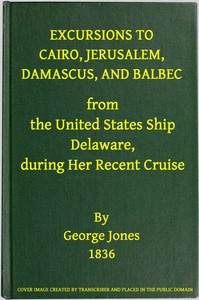
Excursions to Cairo, Jerusalem, Damascus, and Balbec From the United States…
Published in 1836, this book is the personal travelogue of Lieutenant George Jones of the United States Navy. While stationed in the Mediterranean, he seized the chance for an extended leave to explore regions most of his countrymen only knew from the Bible or sensationalized reports. The narrative follows his journey from the United States, across the Atlantic, and into the heart of the Ottoman Empire.
The Story
Jones structures his account as a series of letters, giving it an immediate, personal feel. He lands in Alexandria and makes his way to Cairo, describing the chaos, the grandeur of the pyramids, and his ascent of the Great Pyramid itself. From Egypt, he travels to Jerusalem, documenting the holy sites with a mix of reverence and a critical eye for the commercialism already surrounding them. His route then takes him north to Damascus, which he praises for its beauty, and finally to the stunning Roman ruins at Baalbek (which he calls Balbec). The 'plot' is simply his route, but the story is in his reactions—dealing with guides, observing local customs, and constantly comparing what he sees with his own American worldview.
Why You Should Read It
Forget modern, airbrushed travel writing. Jones's voice is direct and unvarnished. His descriptions are vivid because they're grounded in sensory detail: the heat, the smells, the taste of strange food. What makes it compelling today is seeing the 19th century through the eyes of a specific, flawed individual. He's admiring but also judgmental, curious but often culturally blind. You're not getting a historian's analysis; you're getting one man's honest, on-the-ground experience. It's a primary source that hasn't been sanitized. Reading it, you feel the thrill and the hardship of travel in an era before guidebooks and smartphones.
Final Verdict
This is a perfect pick for readers who love real adventure stories and raw history. If you enjoy peeking into the past through personal diaries, or if you're fascinated by early American encounters with the wider world, you'll be glued to this. It's also great for travelers who want to reflect on how much the experience of 'seeing the sights' has changed. Just be prepared: Jones was a man of his time, and some of his views will make you cringe. But that's part of what makes his journal so genuinely revealing. Approach it not as an expert guide, but as a fascinating conversation with a well-traveled, opinionated sailor from 200 years ago.
No rights are reserved for this publication. You do not need permission to reproduce this work.
Mark Miller
2 years agoWow.
Lucas Torres
2 months agoCompatible with my e-reader, thanks.







Barbara Thompson
1 month agoBefore I started my latest project, I read this and it manages to maintain a consistent flow even when discussing difficult topics. The price-to-value ratio here is simply unbeatable.