
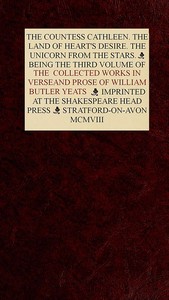
The Collected Works in Verse and Prose of William Butler Yeats, Vol. 3 (of 8)
Let's be clear: this isn't a novel with a single plot. Think of it more like a backstage pass to one of the most creative minds of the 20th century. Volume 3 of Yeats's Collected Works is a snapshot of his life and work from about 1902 to 1908. It's packed with his plays from the early days of the Abbey Theatre, like On Baile's Strand and Deirdre, alongside some of his most famous early poems.
The Story
The "story" here is the story of Yeats figuring out what kind of artist he wants to be. The book is split between two big projects. First, there's his work for the Irish Literary Revival—these are the plays and poems meant to give Ireland its own heroic stories, to stir national pride. They're full of warriors, tragic queens, and ancient legends. But right beside them, you find poems that are deeply personal. These are the ones about his long, complicated love for Maud Gonne, his frustrations, his dabbling in occult societies, and his growing fear that life's best moments are fleeting. So the central tension isn't between characters in a play; it's between the poet's public duty and his private soul.
Why You Should Read It
I love this volume because it shows a genius in progress, not a finished monument. You don't have to choose between the "nationalist Yeats" and the "mystical Yeats"—you get both, wrestling on the page. One minute he's crafting a tight, dramatic scene for the stage; the next, he's writing a hypnotic, musical poem like "The Folly of Being Comforted." It's this clash that makes him so interesting. You see the raw material that would later explode into masterpieces like "The Second Coming." Reading this feels like looking at the blueprints for a cathedral.
Final Verdict
This is perfect for anyone curious about how great art is made. It's for readers who love poetry but are intimidated by complete works—this volume is a manageable, focused slice. It's also a great pick for theater fans interested in the roots of modern drama. If you only know Yeats from a few famous poems in an anthology, this book will show you the man behind them: ambitious, conflicted, and endlessly trying to bridge the gap between this world and the next. Just be ready to think and feel a lot.
No rights are reserved for this publication. Preserving history for future generations.
John Anderson
1 year agoBefore I started my latest project, I read this and the wealth of information provided exceeds the average market standard. I feel much more confident in my knowledge after finishing this.
Donald Gonzalez
2 years agoThe clarity of the introduction set high expectations, and the transition between theoretical knowledge and practical application is seamless. It cleared up a lot of the confusion I had previously.
Richard Miller
1 year agoI decided to give this a try based on a colleague's recommendation, the author clearly has a deep mastery of the subject matter. A perfect balance of theory and practical advice.
Thomas Jones
4 months agoGiven the current trends in this field, the historical context mentioned in the early chapters is quite enlightening. Truly a masterpiece of digital educational material.



George Thomas
11 months agoI stumbled upon this title during my weekend research and the quality of the diagrams and illustrations (if applicable) is top-notch. Thanks for making such a high-quality version available.