
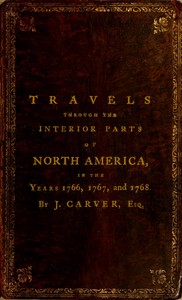
Travels Through the Interior Parts of North America, in the Years 1766, 1767…
Okay, let's set the scene. The year is 1766. The huge war between France and Britain for control of North America is over. Britain won a massive, mostly unknown chunk of land west of the Appalachian Mountains. Jonathan Carver, a former army captain and mapmaker, volunteers to go see what they actually just bought. With little more than official permission and a lot of grit, he sets out from Boston, aiming for the heart of the continent.
The Story
This isn't a plotted novel, but the journey itself provides the narrative. Carver travels by canoe and on foot from the Great Lakes into what is now Minnesota and Wisconsin. He describes the landscape with awe—endless forests, vast prairies, and mighty rivers like the Mississippi. He spends winters in Native American villages, learning to survive. A big part of his goal was to find a Northwest Passage, a water route to the Pacific Ocean. While he never found it, his detailed notes on the geography were used for decades. The real story, though, is in his encounters. He writes about the Dakota, the Ojibwe, and others, not just as 'savages' but as complex societies with their own leaders, diplomacy, and ways of life. He records their words, their ceremonies, and even includes a vocabulary list.
Why You Should Read It
You should read this because it removes all the filters. This is a person from the 1700s telling you, directly, what he saw and felt. There's no modern historian interpreting it for you first. You feel his frustration with harsh weather, his fascination with new plants and animals, and his genuine respect for the people who kept him alive. It's a powerful reminder of how big and wild America once was. You also get a clear, unvarnished look at the moment just before everything changed—before settlers flooded in and these independent nations were overwhelmed.
Final Verdict
This book is perfect for anyone who loves real adventure stories or early American history. If you enjoy the journals of Lewis & Clark, this is the fascinating prequel. It's also great for people interested in Native American history from a primary source, though you have to read it knowing it's an 18th-century British perspective. It's not a fast-paced thriller; it's a slow, immersive experience. Pour a cup of coffee, open this book, and let Carver take you on a canoe trip into the past. You'll come back feeling like you've been somewhere truly remote.
This title is part of the public domain archive. It is now common property for all to enjoy.
Charles Hernandez
11 months agoUnlike many other resources I've purchased before, the language used is precise without being overly academic or confusing. Definitely a five-star contribution to the field.
Ashley Jackson
6 months agoBefore I started my latest project, I read this and the case studies and practical examples provided add immense value. This adds significant depth to my understanding of the field.
Karen Harris
8 months agoI particularly value the technical accuracy maintained throughout.
Linda Hernandez
10 months agoI found the data interpretation to be highly professional and unbiased.








Thomas Anderson
1 year agoGreat value and very well written.